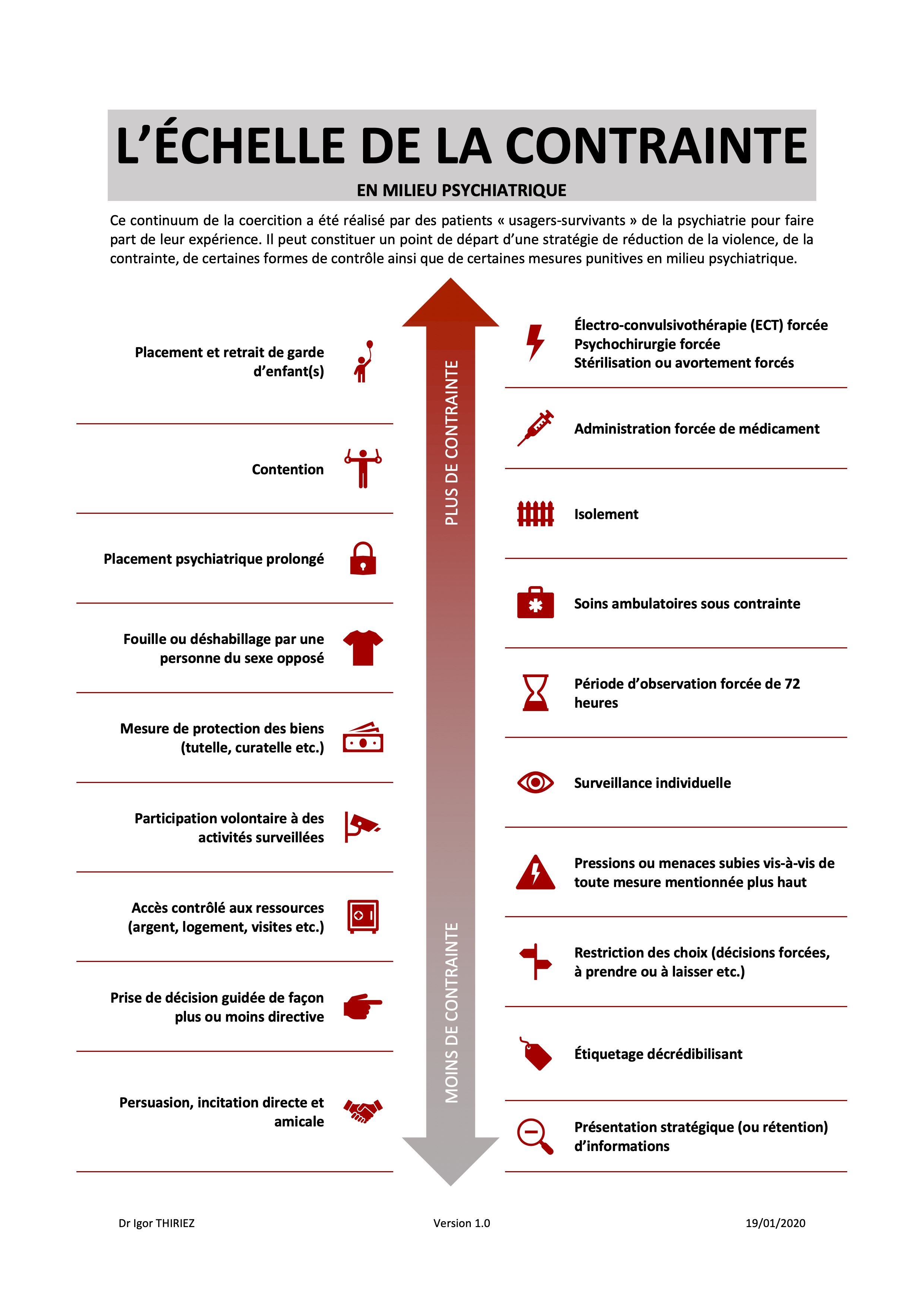
Ce continuum de la coercition a été réalisé par des patients « usagers-survivants » de la psychiatrie pour faire part de leur expérience. Il peut constituer un point de départ d’une stratégie de réduction de la violence, de la contrainte, de certaines formes de contrôle ainsi que de certaines mesures punitives en milieu psychiatrique.

- Curtis, L. C., & Diamond, R. (1977). Power & coercion in mental health services. In B. Blackwell (Ed.), Treatment Compliance and the Therapeutic Alliance (97-122). Toronto, Canada: Harwood Academic Publishers.
- Blanch, A., & Prescott, L. (2002) Making a Commitment to Nonviolence and Recovery in Mental Health Treatment Settings. Report from the National Experts Meeting on Conflict Management and Alternative Dispute Resolution. National Association of State Mental Health Program Directors (NASMHPD) and the National Technical Assistance Center for State Mental Health Planning (NTAC).
- Olofsson, B., Jacobsson, L. (2001). A plea for respect: involuntarily hospitalized psychiatric patients’ narratives about being subjected to coercion. Journal of Psychiatric and Mental Health Nursing, 8: 357-366.
- Sibitz, I., Scheutz, A., Lakeman, R., Schrank, B., Schaffer, M., & Amering, M. (2011). Impact of coercive measures on life stories: Qualitative study. British Journal of Psychiatry, 199(3), 239-244.
- Van Der Merwe, M., Muir‐Cochrane, E., Jones, J., Tziggili, M. and Bowers, L. (2013), Improving seclusion practice: implications of a review of staff and patient views. Journal of Psychiatric and Mental Health Nursing, 20: 203-215


Laisser un commentaire